A serious accident changes your routine fast. One day you are heading to work or picking up your kids, and the next you are dealing with an emergency room bill, a car in the shop, and a phone call from an insurance adjuster who wants a recorded statement. If this happened to you in Decatur, Chamblee, Clarkston, Dunwoody, or anywhere else in DeKalb County, you may be wondering how to file a personal injury claim and what Georgia law expects of you along the way.
At Marks Law Group, we have represented injured DeKalb County residents since 2009. Attorney Aaron P. Marks handles client calls personally, so you are never stuck working through an intake line. If you want to talk through your situation, contact us for a free consultation, and we will walk you through your options.
Five Steps to Filing Your Claim

Here is the short version of what filing a claim generally involves:
- Get medical attention and keep your records.
- Report the accident to the police or property owner and get a copy of the accident report.
- Notify the at-fault party’s insurance company, but avoid giving a recorded statement without advice.
- Watch Georgia’s two-year filing deadline under O.C.G.A. § 9-3-33.
- File suit in the proper court, usually the State Court of DeKalb County, if a fair settlement cannot be reached.
What Counts as a Personal Injury Case in DeKalb County
Georgia personal injury law covers a wide range of situations where someone else’s carelessness caused your injury. The most common injury cases we see in DeKalb County include:
- Motor vehicle accidents, including car, truck, and motorcycle crashes, rear-end collisions, and highway crashes
- Uber and rideshare accidents, along with non-emergency medical transport (NEMT) accidents
- Bicycle and pedestrian accidents, often involving DeKalb’s busy commuter corridors
- Premises liability and slip and fall claims, involving hazardous property conditions like broken stairs, poor lighting, negligent security, or swimming pool accidents, along with fires and explosions or structural problems caused by a property owner’s neglect
- Wrongful death claims, filed on behalf of a family member
- Catastrophic injury cases, including traumatic brain injury and spinal cord injury
We also handle a dedicated line of Walmart injury claims in Georgia. Medical malpractice is a separate, more specialized area of personal injury law with its own pre-suit rules, and we can point you toward the right resources if that describes your situation.
One note on workplace injuries: if you were hurt on the job by someone other than your employer, such as a distracted driver during a delivery run, you may have a separate third-party liability claim in addition to any workers’ compensation benefits. That is a different legal process from a standard injury claim, and it deserves its own conversation with an attorney.
Georgia’s Deadlines and Fault Rules
Two legal rules shape almost every personal injury case filed in DeKalb County.
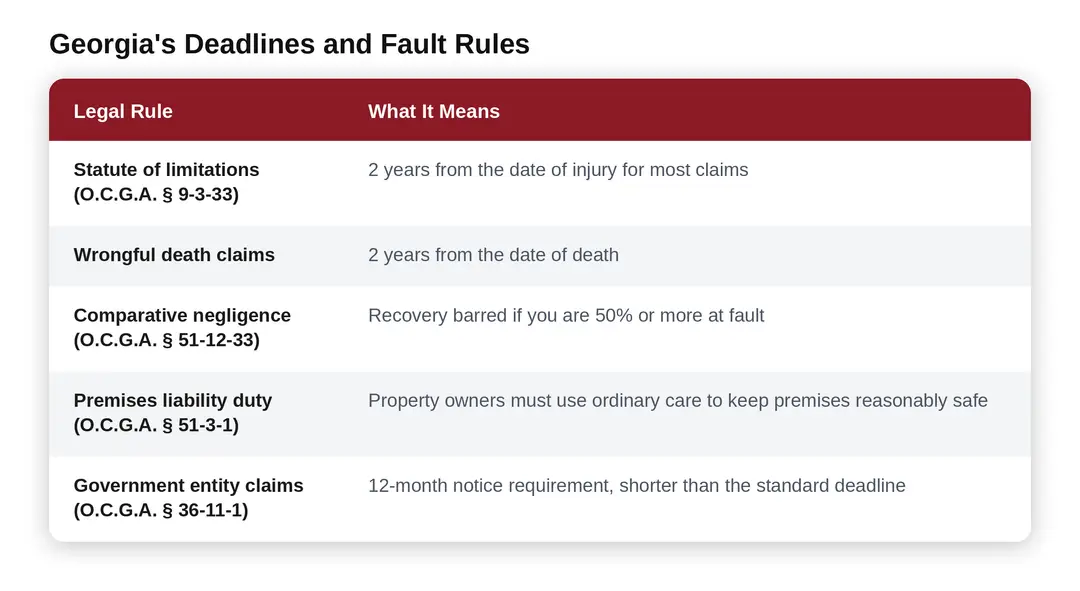
Georgia’s personal injury statute of limitations. Under O.C.G.A. § 9-3-33, you generally have two years from the date of the injury to file a personal injury lawsuit in Georgia. For a wrongful death claim, that two-year clock usually starts on the date of death instead. Miss the deadline, and the court will almost always dismiss the case, no matter how strong the evidence is.
Georgia’s comparative negligence rule. Georgia follows a modified comparative negligence rule under O.C.G.A. § 51-12-33. If you are found less than 50 percent at fault for your own accident, you can still recover damages, reduced by your percentage of fault. If you are found 50 percent or more at fault, Georgia law bars recovery entirely. Insurance adjusters know this rule well, which is one reason they often push to assign injured people more blame than the facts support.
Georgia’s premises liability laws. Under O.C.G.A. § 51-3-1, a property owner or occupier who invites people onto their land generally must exercise ordinary care to keep the property and its approaches reasonably safe. This is the legal standard behind most slip and fall, negligent security, and other premises liability claims in DeKalb County.
A shorter deadline for government claims. If the at-fault party is a government entity, such as a crash involving a DeKalb County vehicle, the rules change. Claims against DeKalb County government itself generally require a formal written notice within 12 months, handled through the county’s legal office, not the standard two-year window. This is a fast-moving deadline, so do not wait to get legal advice if a government vehicle or employee was involved.
Steps to Take After an Accident in DeKalb County

What you do in the days after an accident can affect your claim later on.
- Get medical attention right away, even if you feel fine. Some injuries, like soft tissue injuries or a concussion, do not show symptoms immediately, and an emergency room or urgent care record creates an early, dated account of your injuries.
- Get a police or incident report. For car and truck accidents, call the police to the scene. For a slip and fall or other premises liability case, ask the property owner or manager for an incident report and get it in writing.
- Document the scene. Photos of the hazard, the vehicles, and your injuries can matter more than memory once time passes.
- Keep your medical records and medical bills organized. Detailed medical documentation connects your injury directly to the accident, which matters for both settlement talks and civil litigation.
- Be careful with the insurance company. Insurance adjusters are trained to gather statements early, before you know the full extent of your injury. You are not required to give a recorded statement, and it often helps to talk to an attorney first.
How the Claims Process Works
Most personal injury cases start with a claim against the at-fault party’s insurance company, not a lawsuit. Your attorney gathers the police report, medical records, and evidence of lost income, then sends a demand to the insurer.
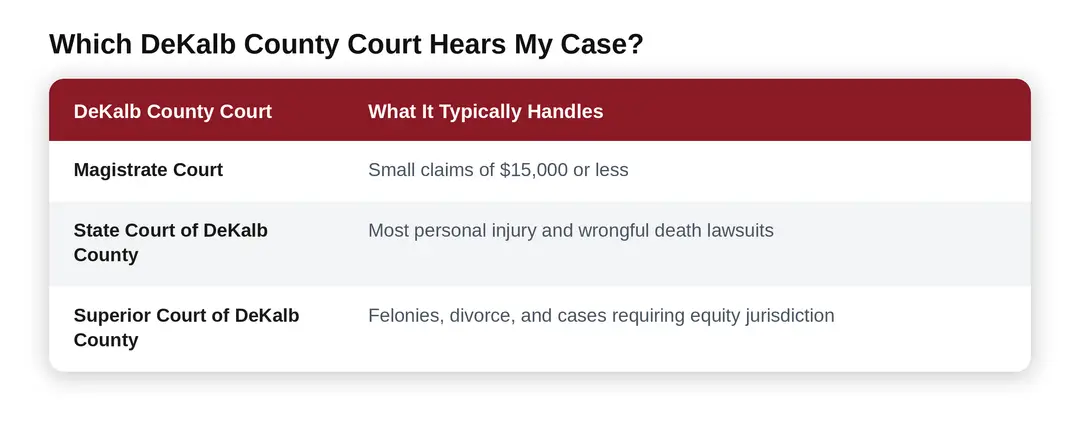
If the insurance company will not offer a fair settlement, the next step is civil litigation. In DeKalb County, that usually means filing in the State Court of DeKalb County, which handles the majority of civil damages cases, including car accidents, truck accidents, and premises liability claims. DeKalb County’s Superior Court instead focuses on felony criminal cases, divorce, and matters requiring equity jurisdiction. Very small claims, generally $15,000 or less, may be handled in Magistrate Court instead.
Venue for a personal injury lawsuit generally depends on where the defendant lives or does business, or where the accident happened, which is why DeKalb County is the proper venue for many local injury cases.
What Can Affect the Value of Your Claim
There is no set formula for what a personal injury claim is worth, and any attorney who promises you a specific number before reviewing your case is getting ahead of the facts. What we can say is that several factors typically shape a claim’s value, including:
- The type and severity of the injury, from soft tissue injuries to a traumatic brain injury or spinal cord injury
- How complete and consistent your medical records and medical bills are
- Whether fault is contested and how comparative negligence might apply
- The available insurance coverage on the at-fault party’s policy
An attorney can review these details for your specific case and explain what to expect, without guessing at a dollar figure in advance.
Why Local Representation Matters

Aaron P. Marks founded Marks Law Group in 2009 after training at a large Atlanta firm, and he earned his law degree at Georgia State University. He is a member of the State Bar of Georgia, the DeKalb Bar Association, and the Georgia Trial Lawyers Association, and he holds a 10 out of 10 rating on Avvo along with recognition as a Georgia Super Lawyer. Aaron handles client calls personally rather than routing them through an intake team, and our paralegal Danette is often the friendly, familiar voice clients hear throughout their case.
Ready to Talk About Your Case?
Every DeKalb County accident is different, and the deadlines above will not wait while you decide what to do next. Contact Marks Law Group for a free, no-obligation case review, and let us help you understand your options.
Frequently Asked Questions
How long do I have to file a personal injury claim in DeKalb County?
In most cases, Georgia law gives you two years from the date of the injury under O.C.G.A. § 9-3-33. Claims against a government entity have a much shorter notice deadline, so it helps to confirm your specific deadline early.
What happens if I was partly at fault for my accident?
Under Georgia’s comparative negligence rule, you can still recover damages if you are found less than 50 percent at fault, though your award is reduced by your percentage of fault. If you are found 50 percent or more at fault, you cannot recover.
Which court hears personal injury cases in DeKalb County?
Most personal injury and wrongful death lawsuits are filed in the State Court of DeKalb County. Very small claims may go to Magistrate Court, and Superior Court handles different types of cases, like felonies and divorce.
Do I need a police report to file a claim?
A police or incident report is not always legally required, but it creates an official record of what happened and is one of the most useful pieces of evidence in a claim.
Do I have to accept the insurance company’s first offer?
No. Insurance adjusters work for the insurance company, not for you, and an early offer does not have to be your final one. It often helps to talk to an attorney before accepting an offer or giving a recorded statement.