A collision with a commercial truck rarely looks like a typical car accident. The difference in size and weight between a car and a truck often means broken bones, spinal cord damage, traumatic brain injury, or worse for the people in the smaller car. If a truck accident has upended your life in Decatur or anywhere in DeKalb County, Marks Law Group can review what happened and explain your options.
Truck accident claims are more complex than regular car accidents due to federal regulations, black box data, and numerous liable parties. Aaron P. Marks, an experienced attorney in Georgia, personally handles client calls, ensuring personal attention from the start of your case without going through intermediaries.
Trucking insurers respond to crashes fast, often before victims exit the hospital, to control the narrative and gain negotiation leverage. Early personal injury attorney involvement can help balance this advantage.
Call Marks Law Group at (678) 500-8766 for a free initial consultation with one of our experienced Georgia truck accident lawyers.
What a Decatur truck accident claim involves
A truck accident claim asks a simple question with a complicated answer: who was responsible, and how much did the crash cost you? Unlike a crash between two passenger cars, a trucking case often has more than one potential defendant.
Depending on the facts, liability can extend to:
- The truck driver, if driver error, fatigue, or a rule violation caused the crash
- The trucking company, if it pushed unsafe schedules, skipped maintenance, or failed to properly train or supervise the driver
- The company that loaded the cargo, if a shifting or overloaded load caused the truck to roll over or jackknife
- The manufacturer of the truck or one of its parts, if defective brakes or another mechanical failure played a role
Because federal law requires trucking companies to carry higher insurance minimums than passenger vehicles, a trucking case can also involve larger insurance policies and more aggressive insurance defense than a typical car accident or motorcycle accident claim. In multi-defendant cases, more than one insurer may be involved at the same time, each trying to shift responsibility to someone else.
If the truck driver or trucking company is underinsured, your UM coverage might cover the gap. We assess your coverage in every case, as it can affect recoverable amounts.
Did you know? We also help with wrongful death claims
Types of truck accidents we see in Georgia
Truck crashes tend to fall into a handful of recurring patterns, and the pattern often points investigators toward the cause:
- Jackknife accidents. The trailer swings out from the cab, often from hard braking, an unsecured load, or a slick road surface.
- Underride accidents. A smaller vehicle slides partially beneath the truck’s trailer, typically in a rear-end or side collision.
- Rollover and cargo accidents. An overloaded or improperly secured load shifts in transit, making the truck unstable.
- Rear-end and head-on collisions. These are often linked to driver fatigue, distracted driving, or a truck’s longer stopping distance.
- Cargo accidents. Loose or falling cargo can strike other vehicles directly, separate from any collision with the truck itself.
The pattern of a crash often points to its cause well before an investigation is complete, which is one reason early evidence preservation matters so much in these cases.
What causes truck accidents
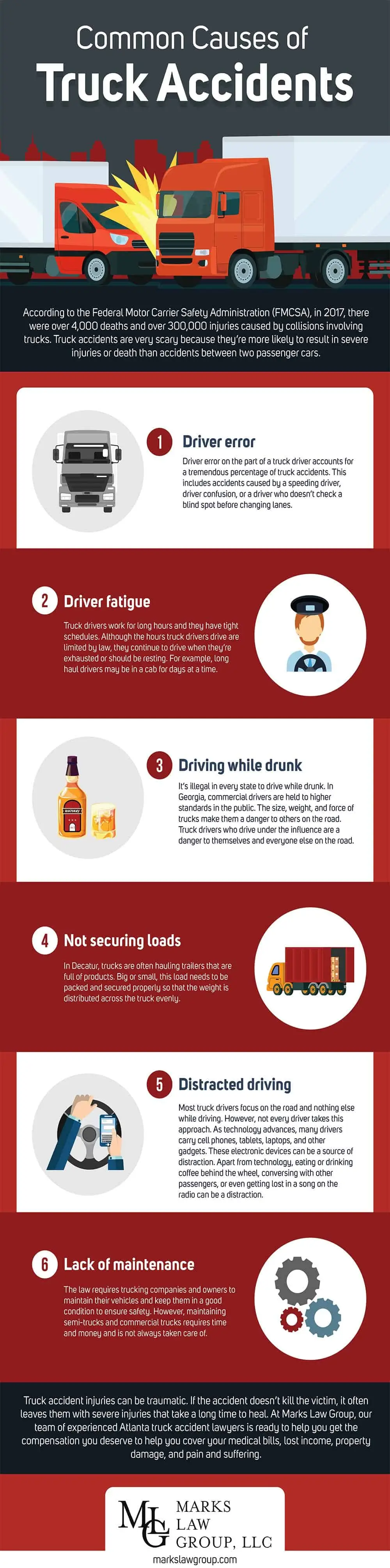
Truck accident causes usually trace back to a decision made by a driver, a trucking company, or both. Common factors include:
- Driver fatigue. Long-haul schedules push drivers close to federal hour limits, and fatigue slows reaction time the same way alcohol does.
- Distracted driving. A cell phone, GPS system, or conversation can pull a driver’s attention away for the few seconds it takes to cause a crash.
- Impaired driving. Commercial drivers are held to a lower blood alcohol limit than other motorists, and any impairment behind the wheel of an 80,000-pound vehicle is dangerous.
- Improper cargo loading. An unsecured or overloaded trailer shifts weight unpredictably, especially during turns or sudden stops.
- Poor maintenance. Defective brakes, worn tires, and skipped inspections are a leading cause of Georgia truck crashes.
The legal framework that applies
Georgia law sets specific rules that shape every truck accident claim in the state.
Statute of limitations. Georgia law generally gives injury victims two years from the date of the crash to file a personal injury lawsuit, under Georgia Code Section 9-3-33. Missing this deadline can permanently bar a claim, so it helps to talk to an attorney well before it approaches.
Comparative negligence. Georgia follows a modified comparative negligence rule. An injured person can still recover damages even if they were partly at fault, as long as their share of fault is under 50 percent. Recovery is reduced by that percentage, and it is barred entirely at 50 percent or more.
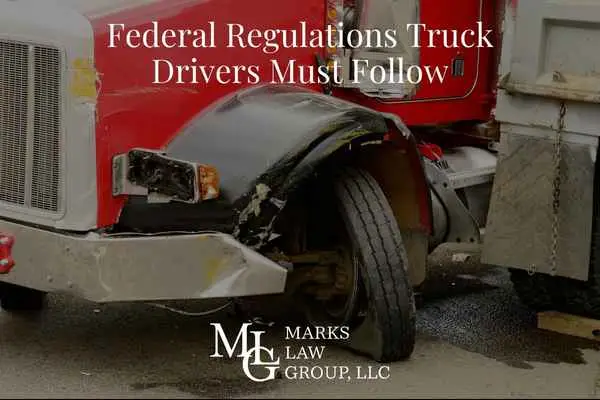
Federal trucking rules. Commercial drivers must also follow Federal Motor Carrier Safety Administration (FMCSA) regulations that do not apply to ordinary drivers, including limits on driving and on-duty hours, mandatory rest breaks, and cargo securement standards. A violation of these rules can be strong evidence of negligence.
Related: We also help with
cases.
Building the Claim: Evidence is Crucial
Trucking cases are won or lost on evidence, and that evidence can disappear quickly. During this legal process, some of it, like a truck’s electronic logging data, may only need to be preserved for a limited time before a trucking company can legally erase it.
Evidence that commonly supports a truck accident claim includes:
- The police accident report
- Photos of the vehicles, road conditions, and skid marks at the scene
- Electronic logging and black box data from the truck
- The driver’s hours-of-service records and personnel file
- Witness statements
- Traffic camera or dash camera footage, where available
In more complex cases, outside professionals such as accident reconstructionists or trucking safety consultants may be brought in to explain how the crash happened and who bears responsibility. If a case cannot be resolved through negotiation, this evidence also forms the foundation of a personal injury lawsuit filed in court, including through the discovery process, where each side can formally request documents and testimony from the other.
We cover the claims process and preserving this kind of evidence in more depth in our guide to federal trucking regulations and accident claims, and in the basics of truck accidents.
Factors that can affect what a claim is worth
No two truck accident cases are valued the same way, and anyone who promises a specific number before reviewing your case is getting ahead of the facts. Factors that commonly affect a claim’s value include:
- The severity and permanence of the injury
- Current and future medical bills and medical expenses
- Lost wages and reduced future earning capacity
- Property damage to the vehicle
- Pain and suffering
- How clearly liability can be shown, and whether more than one party shares fault
We walk through how damages are calculated and how comparative fault can reduce a recovery in our guide on what damages you can collect after a Georgia truck accident.
Related: If you’ve been in an accident and have a
, reach out to our attorneys today.
Local jurisdiction context
Truck accident claims filed out of Decatur typically proceed through the DeKalb County State or Superior Court. DeKalb County includes major freight corridors, and truck traffic on routes near I-285 and I-20 is a regular contributor to serious crashes in the area. Local investigators, including the DeKalb County Police Department and, depending on where the crash occurred, the Decatur Police Department, are often the first agency to document the scene, and their report becomes a key piece of evidence in the claim.
Georgia’s large-truck crash numbers have shifted over the past several years, with state safety data showing changes in both total truck crashes and truck-related fatalities year over year. Because these figures are updated annually, we review the most current data available from Georgia’s Governor’s Office of Highway Safety when it is relevant to a specific case, rather than relying on older statistics.
Contact Our Truck Accident Lawyers in Decatur Today for Legal Advice!
Aaron P. Marks has spent years representing injured people across Decatur, DeKalb County, and the wider Atlanta area, with a focus that includes trucking accidents. When you call our office, you are not screened by an intake team and passed along. Aaron reviews personal injury cases personally and stays involved as they move forward.
We work on a contingency fee basis. Your free case review does not cost anything, and it does not obligate you to hire us. Call our experienced accident attorneys today for a free consultation.